Waterpark — HEALPix Data Hub
Reanalyses, climate model output, campaign data and satellite products, all on the same grid: the data pool, with slides to every level. Pack your floaties!
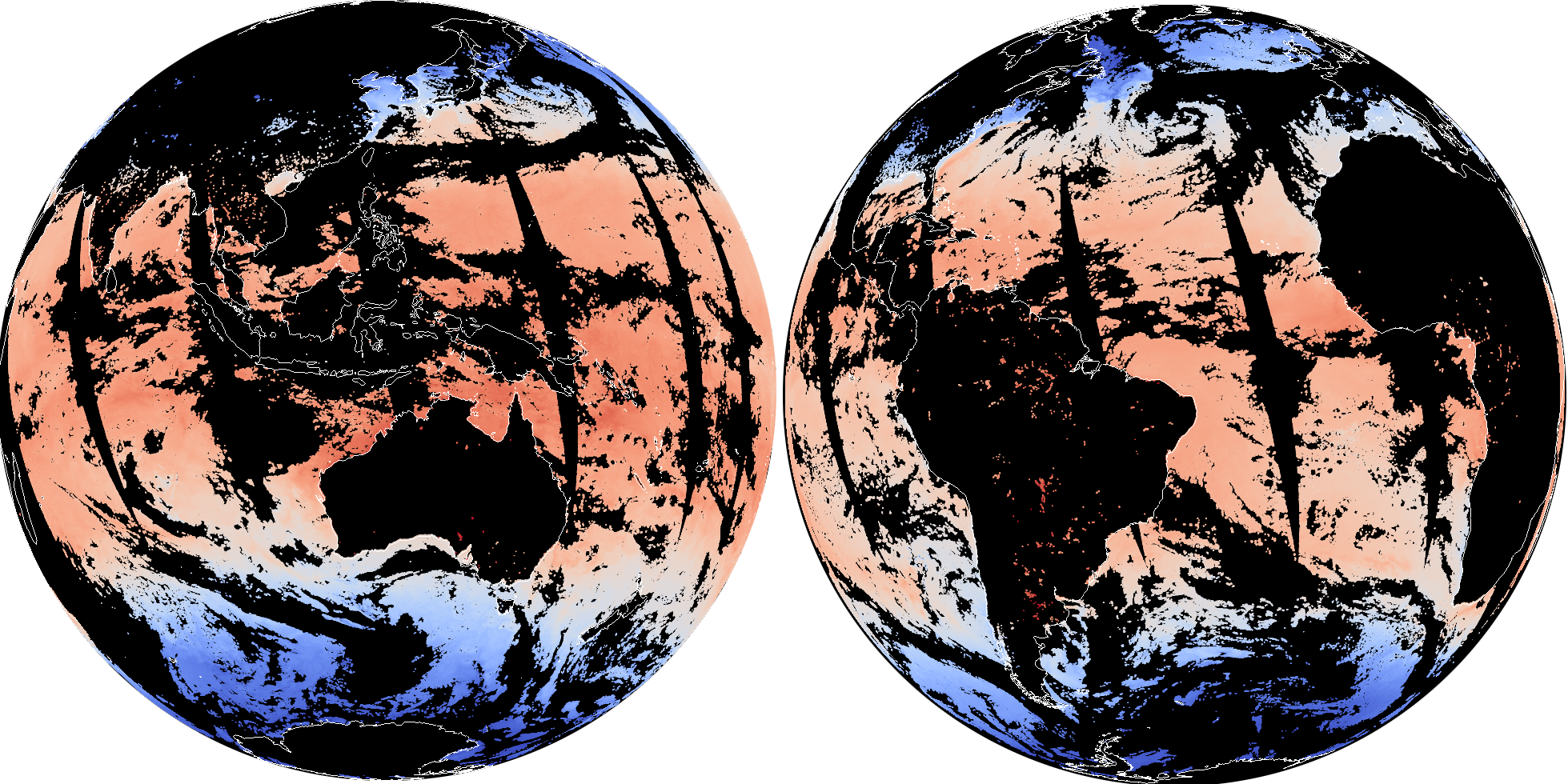
Sea surface temperature seen by MODIS AQUA, remapped to HEALPix level 10.
Cross dataset comparison is easy and intuitive, no regridding:
import xarray as xr

S3 = {"anon": True, "endpoint_url": "https://s3.waterpark.dkrz.de"}

era5 = xr.open_zarr(
    "s3://reanalysis/healpix/era5/P1M/level_5.zarr", storage_options=S3, chunks=None
)
model = xr.open_zarr(
    "s3://nextgems/healpix/ngc4008/P1D/level_5.zarr", storage_options=S3, chunks=None
)

bias = (
    model["tas"].sel(time="2021").mean("time")
    - era5["tas"].sel(time="2021").mean("time")
)
Paths are <project>/healpix/<dataset>/<frequency>/level_<n>.zarr. Every
dataset is written at a range of levels and frequencies; develop against a
coarse monthly store, then change two numbers in the URL.
-
Find a dataset
Search by dataset, variable, level and frequency, and copy the store URL.
-
Walk the catalogue
The same holdings as STAC, for tools that already speak it.
-
Learn by example
Eight short programs, one plot each, from a first map to a cross-dataset comparison.
-
Read the guide
Chunking, regional selection at high levels, and the usual mistakes.
What you can count on
- No regridding. Everything is HEALPix, nested, on one sphere.
- Equal-area cells. A global mean is
field.mean("cell"), nocos(lat). - Read only what you need. Zarr chunks over HTTP.
- A pyramid in space and time. Coarse and monthly, or fine and hourly.
- No mounted filesystem. The same URL from a laptop, Levante or a batch job.
How it got this way
Each source grid is remapped once, conservatively, with
grid-doctor. Coarser levels come
from hierarchical coarsening rather than from remapping again.
Why HEALPix? · Why Zarr and S3? · Remapping decisions · Benchmark
Status
A prototype. The interface is meant to stay stable, but data still comes from DKRZ file systems through an S3-compatible gateway rather than dedicated object storage.